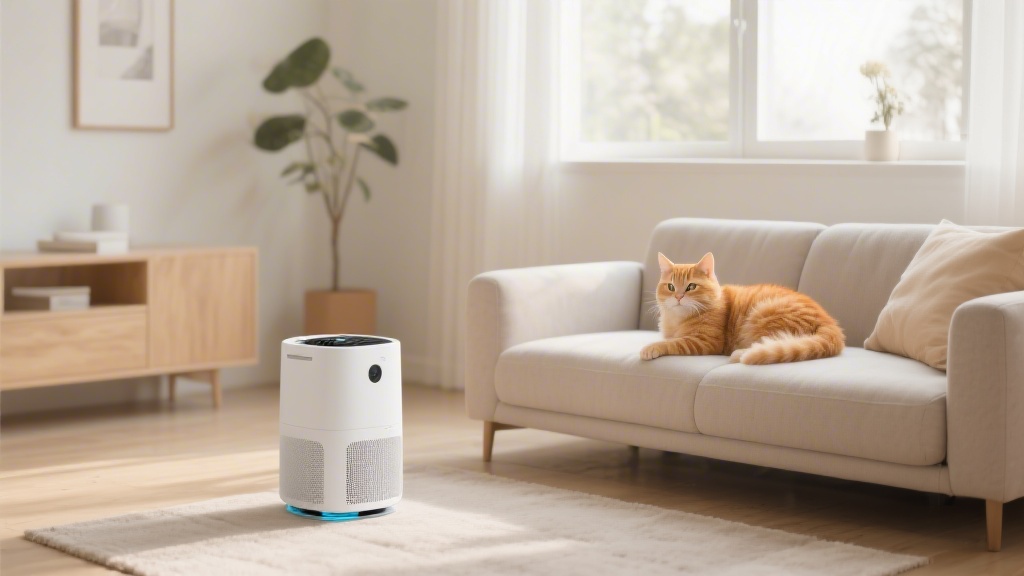
Why Cat Allergies Are So Hard to Deal With
If you love cats but your nose doesn’t, you already know the struggle. Red eyes, constant sneezing, that tight feeling in your chest — it’s miserable. And here’s the thing most people don’t realize: cat allergens aren’t just fur. The real culprit is a protein called Fel d 1, produced in cat saliva, skin, and urine. When your cat grooms itself, this protein gets airborne and sticks to everything — walls, furniture, clothes, even rooms where your cat has never been.
Regular cleaning helps, but it won’t solve the problem on its own. Cat allergens are incredibly small (about 2.5 microns) and can stay suspended in the air for hours. That’s where an air purifier comes in — specifically one designed to capture particles this tiny.
What to Look For in an Air Purifier for Cat Allergies
Not every air purifier will cut it for cat allergies. Here’s what actually matters:
True HEPA Filtration
This is non-negotiable. A True HEPA filter captures 99.97% of particles down to 0.3 microns. Since Fel d 1 particles are around 2.5 microns, a True HEPA filter grabs them easily. Avoid anything labeled “HEPA-type” or “HEPA-like” — those are marketing terms for inferior filters that won’t do the job.
Activated Carbon Filter
Cat owners know the litter box smell situation. An activated carbon filter handles odors, volatile organic compounds, and that general “cat house” smell visitors might notice even when you can’t anymore.
Room Coverage
Match the purifier to your room size — or go bigger. If your living room is 300 square feet, get a purifier rated for at least 300 square feet, ideally more. Undersized purifiers just move air around without cleaning it fast enough.
CADR Rating
Clean Air Delivery Rate tells you how quickly the purifier filters air. For cat allergies, look for a CADR of at least 200 CFM. Higher is better — it means the air gets cleaned more times per hour.
Noise Level
You’ll want this running 24/7, so noise matters. Look for something under 50 dB on medium settings. Some models run as quiet as 24 dB on their lowest setting, which is basically silent.
Best Air Purifiers for Cat Allergies in 2026
After testing and researching dozens of models, these three stand out for cat allergy sufferers:
1. Levoit Core 400S — Best Overall
The Levoit Core 400S hits the sweet spot between performance, price, and features. It covers rooms up to 403 square feet with a CADR of 256 CFM — meaning it cycles the air in a standard living room about five times per hour.
The three-stage filtration (pre-filter, True HEPA, activated carbon) handles cat dander and odors effectively. What sets it apart is the smart features: app control, auto mode that adjusts fan speed based on air quality readings, and scheduling so it ramps up before you get home from work.
Noise-wise, it runs at 24 dB on the lowest setting. You genuinely cannot hear it. On medium, it produces a gentle white noise that most people find pleasant. Filter replacement runs about $40 every 6-8 months depending on use.
Why it works for cat allergies: Strong CADR for the price, effective odor control, and the auto mode means it reacts when your cat is being extra active and kicking up more dander.
2. Coway Airmega AP-1512HH — Best Value
The Coway Airmega AP-1512HH has been a top pick for years, and for good reason. It covers up to 361 square feet with four-stage filtration including a pre-filter, deodorization filter, True HEPA filter, and an ionizer (which you can toggle off if you prefer).
The air quality indicator light gives you real-time feedback — green means clean, and you’ll notice it shift colors when your cat is running around or after brushing them. It also has an eco mode that turns the fan off when it detects clean air for 30 minutes, saving energy.
At around $150-180, it’s one of the most affordable purifiers that actually performs well for pet allergies. Filter replacements cost about $30-40 and last roughly 12 months, making it cheaper to maintain than most competitors.
Why it works for cat allergies: Four-stage filtration at a price that won’t make you wince, plus low maintenance costs mean you’ll actually replace filters on time instead of putting it off.
3. IQAir HealthPro Plus — Best for Severe Allergies
If your cat allergies are serious — we’re talking asthma triggers or anaphylaxis territory — the IQAir HealthPro Plus is the nuclear option. It’s expensive (around $900) but the filtration is on another level.
Instead of standard HEPA, it uses HyperHEPA technology that filters particles down to 0.003 microns — that’s 100 times smaller than what regular HEPA captures. It covers up to 1,125 square feet with a CADR that outperforms most residential purifiers.
The three-stage filtration handles everything from large particles to ultrafine allergens and gases. It’s the purifier allergists actually recommend, and it’s used in hospitals and clean rooms. Yes, it’s bulky and loud on higher settings, but when breathing is on the line, those tradeoffs are easy to accept.
Why it works for cat allergies: If standard HEPA isn’t giving you enough relief, HyperHEPA captures particles that other filters miss entirely. It’s overkill for mild allergies but a lifesaver for severe ones.
Tips to Get the Most Out of Your Air Purifier
Buying the right purifier is step one. Here’s how to make it actually work:
- Run it 24/7. Cat allergens are constantly produced. Turning your purifier off when you leave means you come home to allergen-filled air. Auto mode handles this without wasting energy.
- Place it in your bedroom. You spend 6-8 hours sleeping. If you can only afford one purifier, the bedroom is where it makes the biggest difference.
- Keep doors and windows closed in the room where the purifier runs. You’re fighting a losing battle if outside air keeps flowing in.
- Replace filters on schedule. A clogged filter doesn’t just stop working — it can actually push trapped allergens back into the air. Set a phone reminder.
- Vacuum with a HEPA vacuum too. Air purifiers handle airborne particles, but allergens settle on carpets and upholstery. A HEPA vacuum tackles what’s already landed.
- Brush your cat regularly (outdoors if possible or in a well-ventilated area). This reduces the amount of loose dander floating around your home.
- Wash your hands after petting your cat and avoid touching your face. Simple, but surprisingly effective.
Do Air Purifiers Actually Help With Cat Allergies?
Short answer: yes, with a caveat. Air purifiers significantly reduce airborne allergens, and most cat allergy sufferers report noticeable improvement within a few days of running one. Studies back this up — HEPA air purifiers have been shown to reduce airborne Fel d 1 concentrations by 50-70% in controlled settings.
The caveat is that air purifiers are one piece of the puzzle, not a magic fix. Allergens settle on surfaces, embed in fabrics, and accumulate in places air purifiers can’t reach. You’ll get the best results by combining a good purifier with regular cleaning, keeping cats out of the bedroom (tough, I know), and washing bedding frequently in hot water.
For people with mild to moderate cat allergies, a quality air purifier often makes the difference between constant symptoms and manageable ones. For severe allergies, it’s a necessary tool alongside medication and other environmental controls.
Bottom Line
You don’t have to choose between your cat and breathing comfortably. A True HEPA air purifier won’t eliminate every last allergen, but it will make a real, measurable difference in your indoor air quality.
For most people, the Levoit Core 400S offers the best balance of performance and price. If budget is tight, the Coway AP-1512HH punches well above its weight. And if you’re dealing with severe allergies or asthma, the IQAir HealthPro Plus is worth the investment.
Pick one that matches your room size, run it around the clock, keep up with filter changes, and you’ll wonder why you didn’t get one sooner.